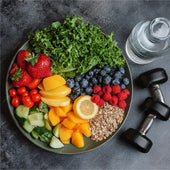

Seven simple high-fiber snacks that you can prepare in 2–15 minutes (excluding time in the fridge or oven), and a table showing how much fiber is actually in your handful of nuts or bowl of berries.
Snacking is the area where a good diet usually "slips." In the afternoon, you want something quick, and cookies or a bar are often close at hand. Fortunately, a healthy snack does not necessarily require much time, and when chosen correctly, it can also be a great opportunity to get more fiber.
This article is based on the recommendations of the European Food Safety Authority (EFSA), the National Health Service (NHS) of Great Britain, the World Health Organization (WHO), and food composition data from the United States Department of Agriculture (USDA). You will find the sources at the end of the article, and they are marked in the text with numbers, for example, [1]. Why high-fiber food is associated with satiety is discussed in more detail in the article “Fiber for weight loss: what satiety can really do.”
Why consider fiber in snacks?
Because most of us are lacking it. EFSA considers 25g of fiber per day to be an adequate amount for normal bowel function in adults [2]. However, the average intake in Europe is significantly lower [3].
| Indicator | Amount per day | Source |
|---|---|---|
| EFSA adequate intake for adults | 25 g | [2] |
| European country recommendations for women | 25–32 g | [3] |
| European country recommendations for men | 30–35 g | [3] |
| Average intake for women in Europe | 16–20 g | [3] |
| Average intake for men in Europe | 18–24 g | [3] |
| Average intake for adults in Great Britain (recommended 30 g) | 18 g | [4] |
The British Dietetic Association estimates that the average intake for adults in Great Britain reaches only 60% of the recommended amount [4]. If you eat 3 meals a day and snack 1–2 times, snacks can help close this gap by a few grams.
What makes a snack healthy?
- Fiber. The NHS suggests fresh fruit, vegetable sticks, rye crackers or oat cakes, unsalted nuts, and seeds as snacks [5].
- Protein. Yogurt, kefir, cheese, nuts, or legumes make a snack more satiating and diverse.
- Low in added sugar. The WHO advises getting less than 10% of total daily energy from free sugars [7]. It is better to get sweetness from fruits and berries.
- Low in salt. Choose unsalted nuts with no added sugar [5]. The WHO recommends adults consume less than 5g of salt per day [7].
- Reasonable portion. A snack should satisfy hunger, not replace lunch.
What is a "reasonable" portion?
The NHS provides simple portion guidelines that are easy to apply to snacks as well [6, 8]:
| Product | One portion | Source |
|---|---|---|
| Fruits or vegetables | 80 g, for example, 1 apple, pear, or banana | [6] |
| Dried fruit | about 30 g | [6] |
| Fruit, vegetable juices and smoothies combined | no more than 150 ml per day | [6, 8] |
| Chocolate, cakes, biscuits, sweet drinks | less frequently and in small quantities | [8] |
How much fiber is in popular snacks?
In the table below, we calculated the fiber content in a standard portion based on USDA food composition data, which is provided per 100g of product [1]. Portions are approximate, and the composition of a specific product may vary slightly, so it is always worth checking the label.
| Product | Portion | Fiber per 100 g | Fiber per portion |
|---|---|---|---|
| Chia seeds | 15 g (about 1 tbsp) | 34.4 g | about 5.2 g |
| Raspberries, fresh | 80 g | 6.5 g | about 5.2 g |
| Chickpeas, canned, drained | 80 g | 6.4 g | about 5.1 g |
| Pear | 150 g | 3.1 g | about 4.7 g |
| Apple with skin (Granny Smith) | 150 g | 2.8 g | about 4.2 g |
| Oatmeal | 40 g | 10.1 g | about 4.0 g |
| Almonds | 30 g (a handful) | 12.5 g | about 3.8 g |
| Hummus | 60 g (3–4 tbsp) | 5.5 g | about 3.3 g |
| Rye crispbreads | 20 g | 16.5 g | about 3.3 g |
| Popcorn, prepared without oil | 20 g | 14.5 g | about 2.9 g |
| Ground flaxseeds | 10 g (about 1 tbsp) | 27.3 g | about 2.7 g |
| Dates (Deglet Noor) | 30 g | 8.0 g | about 2.4 g |
| Raw carrots | 80 g | 2.8 g | about 2.2 g |
| Walnuts | 30 g (a handful) | 6.7 g | about 2.0 g |
| Peanut butter | 16 g (about 1 tbsp) | 5.0 g | about 0.8 g |
See the trend? The most fiber per serving is provided by seeds, berries, legumes, and whole grain products. Therefore, they are the foundation of all seven recipes.

7 healthy high-fiber snacks
1. Chia pudding with raspberries
Ingredients: 2 tbsp chia seeds (approx. 20 g), 150 ml plant-based or dairy milk, 80 g frozen raspberries.
Method: Add milk to the chia seeds and stir. After 5 minutes, stir again to prevent lumps, and leave in the fridge for at least 2 hours or overnight. Sprinkle with raspberries before eating. Prepare in the evening, and by morning or afternoon, the pudding will be waiting in the fridge.
2. Yogurt with raspberries and fiber
Ingredients: 150 g natural yogurt or kefir, 80 g raspberries, 1 teaspoon (5 g) fiber mix, 1 tbsp pumpkin seeds (approx. 10 g).
Method: Stir the fiber mix into the yogurt and leave for a minute to thicken. Top with raspberries and seeds. Drink a glass of water after the snack, as fiber absorbs fluids.
3. Oat energy balls
Ingredients: 100 g rolled oats, 2 tbsp peanut butter, 4 dates (approx. 30 g), 1 tbsp ground flaxseeds, a pinch of cinnamon.
Method: Soak the dates in hot water for 5 minutes, drain, and blend everything in a food processor. If the mixture is too dry, add a tablespoon of water. Shape into 12 balls and keep in the fridge in a sealed container for up to a week.
4. Vegetable sticks with hummus
Ingredients: 1 carrot (approx. 80 g), half a cucumber, half a bell pepper, 3–4 tbsp hummus (approx. 60 g).
Method: Slice vegetables into sticks and dip in hummus. Hummus from chickpeas provides both fiber and protein. Cut the vegetables the night before and keep in a container with a little water to keep them crisp.
5. Crispy roasted chickpeas
Ingredients: 1 can of chickpeas, 1 tbsp olive oil, spices: smoked paprika, garlic powder, a pinch of salt.
Method: Rinse the chickpeas and dry them very thoroughly with a paper towel, as they won't become crispy if wet. Mix with oil and spices, spread in a single layer, and bake at 200°C in the oven for 25–30 minutes, stirring once. Keep in a sealed container for up to 3 days. One serving is approximately one-third of a can.
6. Apple with peanut butter
Ingredients: 1 apple, 1 tbsp peanut butter with no added sugar, a pinch of cinnamon.
Method: Slice the apple with the skin on and eat with peanut butter sprinkled with cinnamon. This snack is also suggested by the British Dietetic Association [4].
7. Raspberry smoothie with fiber
Ingredients: 200 ml kefir or plant-based milk, 80 g frozen raspberries, half a banana, 1 teaspoon (5 g) fiber mix.
Method: Blend everything until smooth and drink immediately before the fiber thickens the drink. If the smoothie is too thick, add a little more water.
How much fiber is in one snack?
| Snack | Preparation time | Fiber per serving (approx.) |
|---|---|---|
| 1. Chia pudding with raspberries | 5 min. + fridge time | approx. 12 g |
| 2. Yogurt with raspberries and fiber | 5 min. | approx. 9.7 g |
| 3. Energy balls (1 unit) | 15 min. | approx. 1.4 g |
| 4. Vegetable sticks with hummus | 5 min. | approx. 5.5 g (without cucumber and pepper) |
| 5. Roasted chickpeas (⅓ can) | 5 min. + 30 min. baking | approx. 5 g |
| 6. Apple with peanut butter | 2 min. | approx. 5 g |
| 7. Raspberry smoothie with fiber | 5 min. | approx. 10.6 g |

Tips to make snacking a habit
- Prepare in advance. On Sunday, make balls or chickpeas for the whole week.
- Keep visible. Fruit on the table, cut vegetables at the front of the fridge.
- Keep supplies at work and in your bag. A handful of unsalted nuts or a serving of fiber in a bag comes in handy when the day runs long.
- Choose fruit, not juice. The NHS advises drinking no more than 150 ml of fruit/vegetable juice and smoothies combined per day [6].
- Drink water. Fiber draws water into the gut, so the British Dietetic Association recommends drinking plenty of fluids alongside it [4].
- Increase fiber gradually. A sudden change can cause bloating and gas [4]. We write more about this in the article “Bloating: common causes and daily habits.”
Important: this data is about fiber and nutrition in general. It is not a description of the effects of the fruttberry product and does not replace professional medical or dietary consultation.
Fiber serving always at hand
In recipes 2 and 7, we used a fiber mix. The fruttberry mix has a strawberry and blackcurrant flavor from real freeze-dried berries, making it suitable for yogurt, kefir, or smoothies.
What is in it?
- Psyllium husk is the base of the mix. We write more about it in the article about psyllium.
- Inulin from agave is a soluble fiber fermented in the gut.
- Freeze-dried strawberries (12%) and blackcurrants (8%) provide taste and color from real berries, not flavoring.
- Glucomannan from konjac (amorphophallus) tubers is another soluble fiber.
100g of the mix contains 77g of fiber. In an independent study by the KTU Food Institute, our mix sample was found to contain as much as 84.4g of fiber per 100g. One teaspoon (5g) provides about 3.86g of fiber and only 11 kcal. The mix contains no added sugar, gluten, lactose, or preservatives and is suitable for vegans.
Since the mix contains glucomannan, it is important to drink enough fluids. EU legislation requires a warning about the risk of choking for people who have difficulty swallowing or when consumed with insufficient fluid [9]. If you drink the mix separately, stir one teaspoon into 200–250 ml of water and drink immediately. If mixing into yogurt or a smoothie, drink a glass of water after the snack. Start with one teaspoon per day and increase the amount every 3–4 days.
The most convenient for work and travel are 30 portions of 5g each, and for home, a 250g package.
All fruttberry dietary fibers in one place.
Frequently asked questions
How many times a day can you snack?
It is individual. For many, one or two snacks between main meals is enough. More important than the number is what you choose.
Are fruits a good snack?
Yes. One fruit portion is 80g, for example, one apple or pear [6]. Eat them with the skin on and combine with a protein source, such as yogurt or nuts.
Are dried fruits suitable for snacking?
They are, but in moderation. A portion of dried fruit is about 30g [6], because sugar becomes concentrated during drying.
Can fiber mix be added to hot porridge?
Yes, just stir it into slightly cooled porridge and, if necessary, add more liquid because fiber thickens it.
How long can energy balls be stored?
In the fridge in a sealed container for up to a week.
Sources
- U.S. Department of Agriculture, Agricultural Research Service. Total Dietary Fiber (g) per 100 g: USDA National Nutrient Database for Standard Reference, Legacy. 2018. Data also available at FoodData Central.
- EFSA Panel on Dietetic Products, Nutrition and Allergies. Scientific Opinion on Dietary Reference Values for carbohydrates and dietary fibre. EFSA Journal. 2010;8(3):1462.
- Stephen AM, Champ MM-J, Cloran SJ et al. Dietary fibre in Europe: current state of knowledge on definitions, sources, recommendations, intakes and relationships to health. Nutrition Research Reviews. 2017;30(2):149–190.
- British Dietetic Association. Fibre: Food Fact Sheet. 2021.
- NHS. How to get more fibre into your diet. Reviewed 2026.
- NHS. 5 A Day portion sizes. Reviewed 2022.
- World Health Organization. Healthy diet. Fact sheet, 2026.
- NHS. The Eatwell Guide. Reviewed 2022.
- European Commission. Commission Regulation (EU) No 432/2012 establishing a list of permitted health claims made on foods. OJ L 136, 2012-05-25, pp. 1–40.
The information provided is general in nature and does not replace a consultation with a doctor or nutritionist. Scientific data are presented regarding fiber and nutrition in general and are not a description of the properties of a specific product. If you have chronic illnesses, are taking medication, are pregnant, or are breastfeeding, consult a healthcare professional before taking food supplements. A food supplement is not a substitute for a varied and balanced diet.