
Chia seeds turn plain milk into a pudding in minutes, and a single spoonful contains several grams of fibre. Find out what they are, how much fibre and omega-3 they contain, why they must be soaked and how to use chia seeds every day.
Chia seeds arrived in Lithuanian kitchens relatively recently, but they quickly became a breakfast classic. They have no strong flavour, absorb liquid and turn into a gel, so they work in both sweet and savoury dishes. Yet the very property we love them for also calls for a little caution.
In this article we draw on food composition data from the U.S. Department of Agriculture (USDA), assessments by the European Food Safety Authority (EFSA), EU legislation and peer-reviewed studies. You will find the sources at the end of the article, and they are marked with numbers in the text, for example [1]. We compare chia with flaxseed in our article “Flaxseed: benefits and how to use it”, and write about fibre in general in our guide “Fibre: what it is and where to find it”.
What are chia seeds?
Chia seeds are the seeds of Salvia hispanica, a plant of the mint family native to Central America. The seeds are small and oval, either greyish-black or white, and their nutritional value is similar.
In the European Union, chia seeds are classed as a novel food, because they were hardly eaten in the EU before 1997. Their use is therefore regulated by EU law:
- 2009: chia seeds were first authorised on the EU market, for use in bread products only [3].
- 2013: they were allowed in baked goods, breakfast cereals, fruit, nut and seed mixes, and as pre-packed chia seeds [3].
- 2020: based on a 2019 EFSA assessment [4], their use was extended to yoghurt, desserts, puddings, beverages and other foods that are not heated at or above 120 °C [3].
How much fibre do chia seeds contain?
According to USDA data, 100 g of chia seeds contains 34.4 g of fibre [1]. That is one of the highest fibre contents among everyday foods. They also contain 17.8 g of alpha-linolenic acid (ALA), a plant-based omega-3 fatty acid, 16.5 g of protein and as much as 631 mg of calcium [1].
| Nutrient | 100 g chia seeds | 1 tbsp (about 10 g) | 2 tbsp (about 20 g) |
|---|---|---|---|
| Energy | 486 kcal | about 49 kcal | about 97 kcal |
| Fibre | 34.4 g | about 3.4 g | about 6.9 g |
| ALA (omega-3) | 17.8 g | about 1.8 g | about 3.6 g |
| Protein | 16.5 g | about 1.7 g | about 3.3 g |
| Total fat | 30.7 g | about 3.1 g | about 6.1 g |
| Calcium | 631 mg | about 63 mg | about 126 mg |
| Magnesium | 335 mg | about 34 mg | about 67 mg |
Chia seed benefits: what can be said responsibly?
Chia seeds are a source of fibre, ALA and plant protein, so they can enrich your everyday diet. EFSA considers 25 g of fibre per day an adequate intake for normal bowel function in adults [7], and two tablespoons of chia provide almost 7 g. In the EU it may be stated that ALA contributes to the maintenance of normal blood cholesterol levels, with the beneficial effect obtained from a daily intake of 2 g of ALA [8]. That amount of ALA is found in roughly 11 g of chia seeds [1]. EFSA has set an adequate intake of ALA for adults of 0.5% of daily energy [9].
These are statements about nutrients, not promises that chia seeds will cure anything. There are still few human studies on chia seeds themselves.

Why must chia seeds be soaked?
In liquid, chia seeds absorb a lot of water and become coated in a gel-like layer. That is how chia pudding is made. But the same property can be dangerous if you swallow the seeds dry.
The medical literature describes a case in which chia seeds absorbed liquid in the oesophagus, turned into a gel-like mass and blocked it, requiring urgent medical treatment [5]. An oesophageal blockage is a medical emergency [5]. Such cases are rare, but there is a lesson to learn:
- Do not eat dry chia seeds by the spoonful and do not wash them down with water straight afterwards.
- Soak them before eating. Cover the seeds with liquid and leave them for at least 10–15 minutes, or for a pudding, a few hours or overnight.
- If you sprinkle them on a dish, choose something moist, such as yoghurt, and keep the amount small.
- Drink enough water throughout the day. Fibre draws water into the gut, so more fibre means you need more fluids [10].
- If you have difficulty swallowing or an oesophageal condition, discuss chia seeds with your doctor.
How to use chia seeds: 6 ideas
- Chia pudding. The classic way, recipe below.
- Yoghurt or kefir. Stir a tablespoon of chia into yoghurt, leave for 15 minutes and top with berries.
- Smoothie. Soak the chia seeds in advance and blend them with fruit or vegetables. The drink will be thicker.
- Porridge. Stir a tablespoon of chia into oat porridge and add more liquid. For more ideas, see our article “Healthy breakfasts: recipes”.
- Baking. Add chia to bread, buns or cookies. Baked goods are one of the longest-authorised uses of chia in the EU [3].
- Egg substitute. Mix a tablespoon of chia seeds with 3 tablespoons of water and leave for 10–15 minutes until it thickens. It works for pancakes, muffins and patties.
Chia pudding: recipe
You will need: 2 tablespoons of chia seeds (about 20 g), 150 ml of plant-based or cow’s milk, a few drops of vanilla extract, a handful of fresh or frozen berries.
Method: pour the milk over the chia seeds, add the vanilla and stir well. After 5 minutes, stir again so no lumps form. Cover and leave in the fridge for at least 2 hours or overnight. Top with berries before eating. If the pudding is too thick, add a spoonful of milk.
One portion like this contains about 6.9 g of fibre from the chia seeds alone [1], and the berries add even more. For more snacks with chia, see our article “Healthy snacks: recipes”.
| Use | How much chia | How much liquid | How long to leave |
|---|---|---|---|
| Pudding | 2 tbsp (about 20 g) | 150 ml | 2 hours or overnight |
| Yoghurt | 1 tbsp | 150 g yoghurt | 15 min |
| Egg substitute | 1 tbsp | 3 tbsp water | 10–15 min |
| Smoothie | 1 tbsp, soaked in advance | 200–250 ml | 15 min before blending |

How many chia seeds can you eat per day?
There is no official daily amount of chia seeds for adults. In practice, 1–2 tablespoons a day is enough for most people. Always follow the manufacturer’s instructions on the pack.
- Start with a smaller amount. If you have not been eating much fibre, a sudden increase can cause bloating and wind [10].
- Count the calories. Two tablespoons of chia contain about 97 kcal [1], so they are a filling addition, not a “free” extra.
- Taking medication? It is better not to take fibre-rich foods and medicines at the same time. If you take several medicines, talk to your doctor or pharmacist.
- For children, discuss the amount of chia seeds with a doctor.
You can read more about how much fibre you need per day in our article “How much fibre do you need per day?”.
Chia seeds and satiety: what does research show?
People often search for “chia seeds for weight loss”. The answer is not that simple. Fibre and protein make a meal more filling, and chia pudding with berries is a satisfying breakfast. However, in a study in which overweight adults ate 50 g of chia seeds a day for 12 weeks, their body mass and body composition did not change [6].
So it makes sense to see chia seeds as one part of a healthy diet, not as a weight tool. What you eat over the whole day matters far more: vegetables, fruit, wholegrains, pulses, nuts and seeds together.
Chia seeds or flaxseed?
| Chia seeds | Flaxseed | |
|---|---|---|
| Fibre per 100 g | 34.4 g | 27.3 g |
| ALA (omega-3) per 100 g | 17.8 g | 22.8 g |
| Calcium per 100 g | 631 mg | 255 mg |
| Energy per 100 g | 486 kcal | 534 kcal |
| Need to grind? | Not necessary, but must be soaked | Ground is better |
| Best for | Pudding, yoghurt, smoothies | Porridge, baking, flaxseed drink |
Chia has more fibre and calcium, flaxseed has more ALA. The two work perfectly side by side.
Important: these data are about chia seeds and nutrition in general. They do not describe the effects of the fruttberry product and do not replace a doctor’s advice.
When there is no time for pudding: the fruttberry fibre blend
Chia pudding needs time in the fridge, and you do not always have seeds at hand, especially at work or when travelling. The fruttberry blend contains no chia seeds or flaxseed. It is a different, convenient additional source of fibre alongside them, for days when you get too little fibre from food.
Ingredients
- Psyllium husk (psyllium) is the base of the blend.
- Agave inulin is a soluble fibre that is fermented in the gut.
- Freeze-dried strawberries (12%) and blackcurrants (8%) give flavour and colour from real berries, not from flavourings.
- Glucomannan from konjac (Amorphophallus) tubers is another soluble fibre.
How much fibre is in one teaspoon?
100 g of the blend contains 77 g of fibre. In an independent test by the KTU Food Institute, a sample of our blend contained as much as 84.4 g of fibre per 100 g. One teaspoon (5 g) provides about 3.86 g of fibre and only 11 kcal. The blend contains no added sugar, gluten, lactose or preservatives, and it is suitable for vegans.
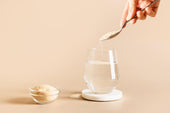
Stir one teaspoon into 200–250 ml of water and drink it straight away, increasing the amount every 3–4 days. Like chia seeds, psyllium and glucomannan swell, so always take the blend with enough water: drinking too little liquid can cause a choking risk. If you have difficulty swallowing, do not take fibres of this kind.
For work and travel, the most practical choice is the 30 single servings of 5 g, and for home the 250 g pack.
All fruttberry dietary fibre products in one place.
Frequently asked questions about chia seeds
Do chia seeds need to be ground?
No. Chia seeds are usually eaten whole, just soaked. Ground chia seeds can also be added to baking.
How long should chia seeds be soaked?
At least 10–15 minutes, so the seeds can swell. For pudding, it is best to leave them in the fridge for 2 hours or overnight. Do not eat dry chia seeds [5].
Is Salvia hispanica the same as chia?
Yes. Chia seeds are the seeds of Salvia hispanica [4].
How much fibre is in a spoonful of chia seeds?
A tablespoon (about 10 g) contains about 3.4 g of fibre, because 100 g of chia seeds contains 34.4 g of fibre [1].
Are chia seeds suitable for children?
Only give chia seeds to children after talking to a doctor, and always soaked, because dry seeds swell [5].
Sources
- U.S. Department of Agriculture, Agricultural Research Service. Seeds, chia seeds, dried (FDC ID 170554). FoodData Central, SR Legacy, 2018.
- U.S. Department of Agriculture, Agricultural Research Service. Seeds, flaxseed (FDC ID 169414). FoodData Central, SR Legacy, 2018.
- European Commission. Commission Implementing Regulation (EU) 2020/24 authorising an extension of use of chia seeds (Salvia hispanica) as a novel food. 13 January 2020.
- EFSA Panel on Nutrition, Novel Foods and Food Allergens (NDA). Safety of chia seeds (Salvia hispanica L.) as a novel food for extended uses pursuant to Regulation (EU) 2015/2283. EFSA Journal. 2019;17(4):5657.
- Simmelink A, Rawl RE, Browne L, Scobey M. Watch it grow: Esophageal impaction with chia seeds. Case Reports in Internal Medicine. 2017;4(2):49.
- Nieman DC, Cayea EJ, Austin MD et al. Chia seed does not promote weight loss or alter disease risk factors in overweight adults. Nutrition Research. 2009;29(6):414–418.
- EFSA Panel on Dietetic Products, Nutrition and Allergies. Scientific Opinion on Dietary Reference Values for carbohydrates and dietary fibre. EFSA Journal. 2010;8(3):1462.
- European Commission. Commission Regulation (EU) No 432/2012 establishing a list of permitted health claims made on foods. OJ L 136, 25 May 2012, pp. 1–40.
- EFSA Panel on Dietetic Products, Nutrition and Allergies. Scientific Opinion on Dietary Reference Values for fats, including saturated fatty acids, polyunsaturated fatty acids, monounsaturated fatty acids, trans fatty acids, and cholesterol. EFSA Journal. 2010;8(3):1461.
- British Dietetic Association. Fibre: Food Fact Sheet. 2021.
The information provided is general in nature and does not replace advice from a doctor or dietitian. The scientific data refer to fibre and nutrition in general and do not describe the properties of any specific product. If you have a chronic condition, take medication, are pregnant or breastfeeding, talk to a healthcare professional before starting any food supplement. A food supplement is not a substitute for a varied and balanced diet.